

Conventional crop rotations get a boost from adding special crops to the mix.
It’s no secret that diversified cropping systems can help combat disease and improve yields. However, little research has been done on how special crops perform and contribute to carbon sequestration, and the productivity and cost-effectiveness of the rotational system on the Prairies.
That’s where this research project, funded in part by the Diverse Field Crops Cluster, comes in.
“We wanted to explore how special crops can be added into rotations and the effect this would have on productivity, economics and the environment,” explains lead researcher Mervin St. Luce of AAFC Swift Current Research and Development Centre. “We looked at how we can integrate special crops that are typically grown on small acres – like mustard, camelina, flax, quinoa, Canary seed and sunflower – into crop rotations that are traditionally dominated by canola, wheat and pulses.”
This research explored how adding special crops into rotations affects productivity, economics, and the environment.
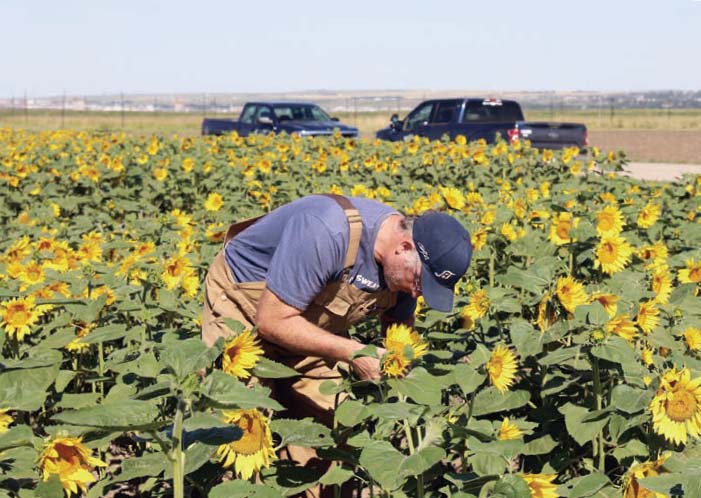
Manjula Bandara, another researcher on the project, says they were particularly interested in investigating the different species of mustard and carinata to see how the glucosinolate properties of each species affected the nitrogen fixing capabilities of the pulse crops that followed, specifically field peas and lentils.
The project included field studies that accounted for soil, weather and agronomic practices, as well as a controlled growth chamber study that assessed the direct net effect on carbon and nitrogen dynamics by growing one crop after another.
Initial findings from the project indicate that yellow mustard and camelina rotations showed the potential of producing a higher number of root nodules in subsequent pulse crops compared to other treatments. Biological nitrogen fixation (BNF) varied with the preceding Brassica oilseed crop species. In general, field pea rotations had higher total BNF than lentil rotations, and field pea following oriental mustard and Argentine canola had the highest total BNF.
The team analyzed glucosinolate levels in the seeds of Brassica species collected from the crop rotation study to demonstrate the effect of Brassica crops on BNF in subsequent eld peas and lentils. The research demonstrated that there was no apparent relationship between Brassica seed glucosinolate contents and BNF capacities in subsequent
pulse crops. Determination of glucosinolate levels in plant tissues was recently completed for a greenhouse study.

“These results tell us that you can grow any type of mustard and not affect the nitrogen fixation of the following pulse crop,” commented St. Luce.
The research team is currently analyzing the economics of specific rotations by investigating the cost of production versus potential income. “We know that for the producer, economics is the driver for all farm decisions,” says St. Luce, “so we are conducting a cost benefit analysis by comparing rotations with these crops to the ones that don’t include special
crops.”
The team hopes this information will lead to higher profits for Prairie farmers and a better understanding of the carbon credits available, based on each crop that makes up their rotation.
St. Luce says it’s not only about economics. “This research will help producers make more informed decisions when it comes to managing nutrients, pests and environmental concerns related to current agriculture practices. It also contributes to our agronomic knowledge of rotational cropping systems and helps develop best management
practices. This has the potential to generate payoff for farmers, the entire agriculture industry and the environment.”
This DFCC research activity is led by Mustard 21 Canada Inc. with funding support from Agriculture and Agri-Food Canada’s Canadian Agricultural Partnership program, Saskatchewan Mustard Development Commission, Canadian Mustard Association, Government of Saskatchewan and Results Driven Agriculture Research.
Mustard 21 Canada Inc. is part of the Diverse Field Crops Cluster. The Diverse Field Crops Cluster (DFCC) is an agri-science cluster whose purpose is to support the research and development of high-potential, special crops.